
Berlin Went Dark
Europe’s richest power failed a basic stress test — and almost nobody noticed

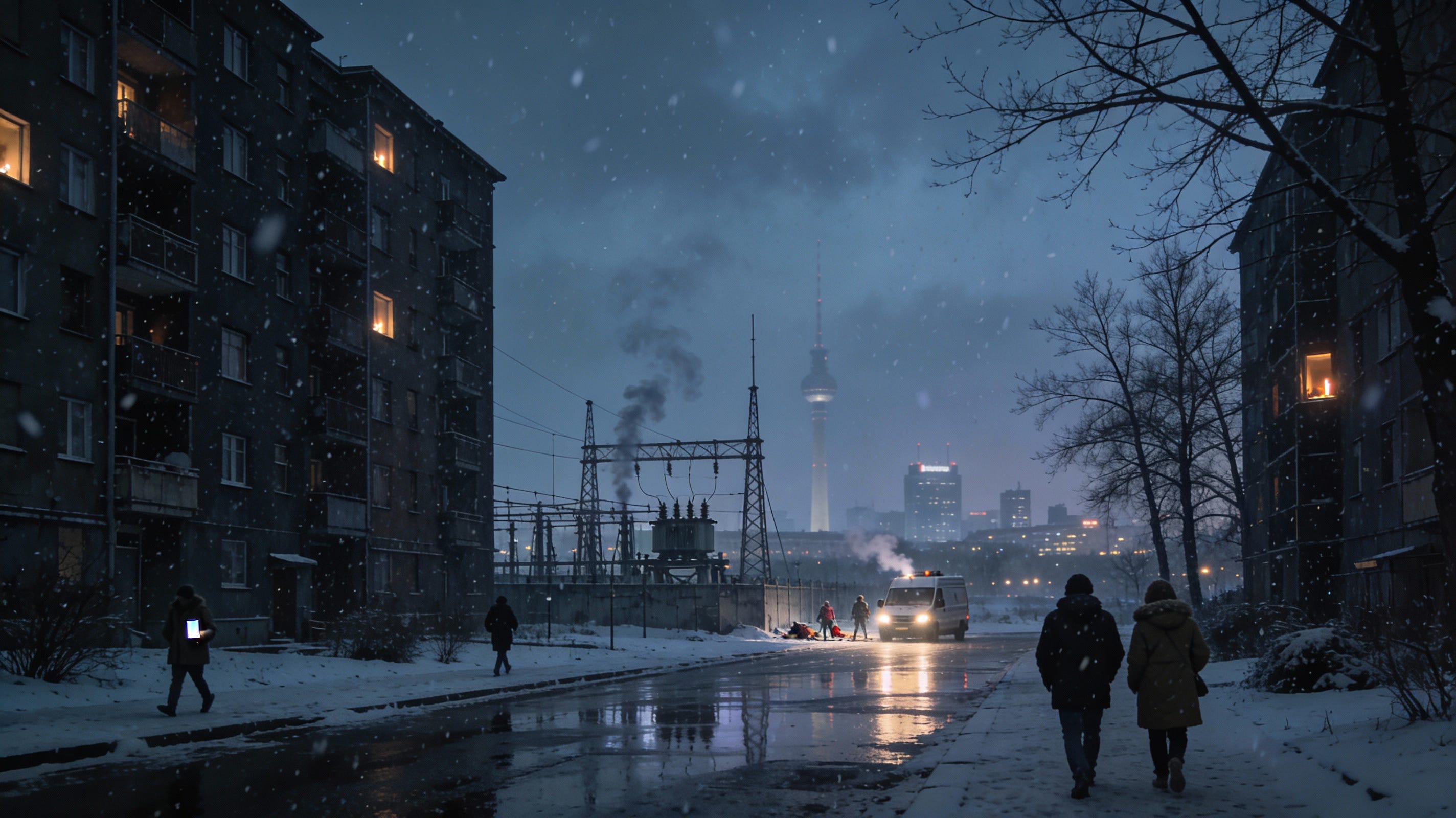
1. The Event That Should Have Shocked the World
On January 3, in the middle of winter, Berlin lost power.
Not briefly, not partially, and not in some distant suburb that could be politely ignored. An entire borough of the German capital went dark after a deliberate arson attack on critical electricity infrastructure. Around 45,000 households were affected. More than 100,000 people suddenly found themselves without heating, without cooking facilities, and with only whatever battery life remained on their phones to stay connected.
This was not caused by a storm, a technical mishap, or an unfortunate coincidence. It was intentional. It was foreseeable. And it happened in the capital of Europe’s largest economy.
What followed was not panic, but something arguably more unsettling: indifference.
Outside Germany, the event barely registered. The global news cycle was busy with its usual cast of characters: Venezuela, Iran, Greenland, the United States. Plenty of spectacle, plenty of outrage. A multi-day blackout in Berlin during winter, by contrast, was treated as a local inconvenience, a technical hiccup to be handled quietly by municipal authorities and then forgotten.
That reaction deserves scrutiny.
Four days without electricity in a capital city is not a trivial disruption. In most parts of the world, it would raise immediate questions about preparedness, governance, and vulnerability. In other countries, Germany itself would likely have offered commentary, analysis, perhaps even instruction. When it happened at home, however, the episode slipped into the background with remarkable ease.
Berlin is not a peripheral city, and Germany is not a marginal state. It sits at the economic and political core of the European Union, plays a central role in NATO, and speaks frequently and confidently about resilience, hybrid threats, and the dangers of infrastructure sabotage. These warnings are usually delivered with the calm authority of someone who believes the lesson has already been learned.
January 3 suggested otherwise.
The lights went out in Berlin, and for a few days, so did the illusion that this could not happen here. What is more troubling than the blackout itself is how quickly it was normalized, minimized, and absorbed — as if a failure of this scale, in this place, at this time of year, required no serious pause.
That quiet acceptance is where the story begins.
2. What Failed Was Not the Grid
The obvious defense came quickly: infrastructure takes time to repair.
That is true, and largely beside the point. Engineers can replace cables. Networks can be stabilized. Power grids, even damaged ones, are solvable problems. In Berlin, repair crews did what repair crews are meant to do. Electricity returned.
What was missing sat elsewhere.
There was no visible parallel plan to carry the population through the gap between failure and restoration. No serious interim provision to replace lost energy capacity at the household level. No coherent effort to keep daily life workable while the grid was offline. The working assumption appeared to be that citizens would adapt individually until the system recovered.
Some managed. They left the affected borough, paid for hotel rooms, or stayed with friends elsewhere in the city. Others had no such margin. They remained in cold apartments during the winter holiday period, cooking nothing, charging phones sparingly, waiting for updates that rarely addressed their immediate reality. The difference between those experiences was obvious, yet it was not reflected in the response.
This distinction matters because resilience is not measured by how fast infrastructure is repaired, but by how well people are supported while it is not. A state that treats restoration as the entire response implicitly shifts the burden of survival onto private means: savings, mobility, social networks, and luck.
That is not emergency management. It is endurance by default.
In a capital city, in winter, in a country that prides itself on order and preparedness, the absence of a civilian fallback plan is not a technical oversight. It is a conceptual one. It reveals a model of public protection that assumes disruptions will be short, tolerable, and absorbed quietly, even when they affect tens of thousands of people at once.
The power outage ended. The exposure in the meantime was treated as an acceptable cost.
3. The Reluctance to Name What Happened
From the outset, officials were careful with language.
The attack was described as sabotage, a term that is technically accurate and politically useful. It keeps the focus on damaged equipment rather than exposed citizens. It frames the event as an operational problem, not as an act directed at a population. In a winter blackout affecting more than 100,000 people, that distinction is doing a great deal of work.
Words matter here because Germany is not shy about naming threats when the circumstances allow it. When violence aligns with the right ideological profile, labels harden quickly. Terrorism is called terrorism. Motive is foregrounded. The moral register rises. Parliamentary debate follows as a matter of course.
In this case, caution prevailed.
The reason is uncomfortable but hard to avoid. The suspected perpetrators came from the hard left, a category that Germany and much of Europe have spent decades treating as disruptive, sometimes criminal, but rarely existential. Infrastructure attacks associated with that milieu have been tolerated as a kind of background noise, something to be managed rather than confronted as a serious security failure with civilian consequences.
Calling this attack terrorism would have complicated that posture. It would have forced a conversation about intent, effect, and proportionality. It would also have raised an awkward question: why actions that deliberately leave civilians freezing in winter are linguistically softened when the ideology behind them is politically familiar.
This is not an argument for rhetorical inflation. It is an argument for consistency. Cutting power to a residential district in winter is not rendered less coercive by the political preferences of those responsible. The impact on the population does not change with the label attached to the perpetrators.
The hesitation to say so suggests a deeper problem than semantics. It points to a security culture that calibrates seriousness not by consequence, but by category. When that happens, preparedness follows the same logic, and blind spots harden into policy.
Berlin did not only lose electricity that week. It briefly exposed how much depends on which threats a state is willing to take seriously in its own backyard.
4. Background News, Federal Silence
Equally revealing was how quickly the episode slid out of view.
More than 100,000 people in the capital of Germany lost electricity in winter, during a holiday period, as the result of a deliberate attack on infrastructure. Under normal circumstances, that combination alone would have warranted sustained national attention. Instead, coverage remained brief and largely technical, framed around repair progress and administrative responsibility. Within days, the story had receded.
This was not because the facts were unclear. It was because they were inconvenient.
German media are capable of saturation coverage when an event is deemed politically significant. Entire news cycles have been devoted to far smaller incidents when the narrative fit established concerns. In this case, the disruption was real, the scale was large, and the implications were uncomfortable. Treating it as background noise avoided the need to ask harder questions about preparedness, accountability, and priority.
The response from the federal level followed a similar pattern.
Formally, this was a local matter. Electricity grids fall under regional responsibility, and federalism provides a ready-made explanation for restraint. In practice, however, this happened in the capital, a short distance from the institutions that represent national authority. Silence, under those circumstances, was not neutral. It was a choice.
There was no attempt to frame the blackout as a warning, no acknowledgment that a failure of this magnitude raised broader concerns about civilian protection, and no visible effort to reassure those affected that the episode was being taken seriously beyond the level of technical repair. The absence was striking precisely because it contrasted so sharply with the confidence usually displayed when Germany comments on governance failures elsewhere.
What emerged instead was a quiet consensus to keep the incident small. It remained a municipal problem, an engineering issue, a temporary inconvenience. The political center stayed largely disengaged, as though drawing attention to the event would grant it more significance than it deserved.
That instinct may be understandable. It is also revealing.
A state’s priorities are often clearest in what it chooses not to elevate. In this case, the combination of muted media treatment and federal reticence suggested a shared reluctance to confront what the blackout implied: that Germany’s capacity to protect its population during a deliberate infrastructure attack is thinner than its rhetoric would suggest.
For the people affected, the message was implicit but clear. This was something to endure, not something that required national reckoning.
5. Lectures Without Demonstration
Germany’s reaction to the blackout becomes more revealing when set against the role it habitually plays beyond its borders.
For years, Berlin has positioned itself as a reference point for responsible governance. It advises others on resilience, preparedness, and institutional maturity. It warns about hybrid threats, infrastructure vulnerability, and the dangers of complacency in an unstable world. These statements are not marginal; they are part of Germany’s self-image as a serious, stabilizing power at the center of Europe.
That posture implies a certain standard at home.
When states elsewhere struggle with blackouts, energy shortages, or emergency response failures, Germany rarely treats these as neutral misfortunes. They are interpreted as indicators of weak institutions, poor planning, or political neglect. The analysis is often sharp, occasionally moralizing, and presented as common sense.
The Berlin blackout sat uneasily with that habit.
Here was a foreseeable disruption, in peacetime, affecting a large civilian population in the capital of the European Union’s strongest economy. Yet there was no visible effort to turn the episode into a moment of reflection, no attempt to draw lessons publicly, and no sense that the state felt compelled to demonstrate the standards it routinely advocates.
This contrast matters because credibility in matters of security and resilience is cumulative. It is built not on declarations, but on performance under mild stress. A country that speaks authoritatively about preparedness is eventually expected to show how that preparedness works when conditions are less than ideal.
In this case, the demonstration never came.
What remained instead was a gap between confidence and capacity, between instruction and example. The blackout did not undermine Germany’s image because the lights went out. It did so because, when they did, there was no visible effort to show that the state could carry its population through the disruption in a way that matched its rhetoric.
That gap is not easily dismissed as a one-off. It raises a quieter, more unsettling question: how much of Germany’s reputation for resilience rests on assumption rather than evidence?
And assumptions, unlike infrastructure, tend to fail precisely when they are most needed.
6. What Preparedness Actually Looks Like
The weakness exposed in Berlin becomes clearer when placed next to a country that has taken the problem seriously.
Finland is smaller, poorer, and far more exposed. It shares a long border with Russia, has a much harsher climate, and lives with the assumption that disruption is not hypothetical. Civil preparedness there is not an abstract virtue or a talking point. It is embedded in planning, budgeting, and public expectation. Backup power, shelters, redundancy, and clear civilian guidance are treated as ordinary features of state responsibility, not as exceptional measures reserved for wartime.
Germany, by contrast, operates on a different premise.
Despite its economic weight and central role in Europe’s security architecture, civilian protection remains thinly developed and unevenly prioritized. Emergency planning exists, but it is often procedural rather than operational, focused on formal competence rather than lived continuity. The Berlin blackout exposed this gap with uncomfortable clarity. When the grid failed, there was no visible depth behind it, no layered system designed to soften the impact on ordinary people.
This contrast is not about geography or culture. It is about mindset.
Finland plans for disruption because it assumes it will happen. Germany plans around disruption because it assumes it will be manageable. The difference shows up precisely when systems are stressed, even briefly. One approach treats resilience as a baseline requirement. The other treats it as an abstract aspiration.
For non-European readers, this matters because Germany is not just another state among many. It is the backbone of the European Union’s economy and a central pillar of its political stability. If a country of this size and wealth struggles to protect a single urban district during a limited, localized incident in peacetime, it raises uncomfortable questions about how it would perform under sustained or coordinated pressure.
Those questions are not alarmist. They are the logical extension of what was observed.
The Berlin blackout was not a worst-case scenario. It was not a rehearsal for war. It was a mild test conducted by reality, not by adversaries. The result was not collapse, but exposure. It showed how quickly assumptions about preparedness give way when they are not supported by concrete systems.
That is why the episode deserves more attention than it received. Not because it was catastrophic, but because it was ordinary. And ordinary failures, left unexamined, tend to scale poorly when conditions deteriorate.
Germany’s lights came back on. The standard it set for itself during the outage remains an open question.
7. Why This Should Worry Everyone Else
It is tempting to treat the Berlin blackout as a local embarrassment, an episode best filed under municipal mismanagement and then forgotten. That temptation is understandable, and it is precisely what makes the episode relevant beyond Germany.
Germany is not operating in a benign environment. It sits on the frontline of overlapping pressures: Russian hybrid tactics, Islamist terrorism, and political extremism from both ends of the spectrum. Its infrastructure is not peripheral; it is central to Europe’s economic and logistical functioning. Its capital is not symbolic alone; it is an operational hub.
What was tested on January 3 was not Germany’s ability to fix cables. It was its ability to absorb disruption without transferring the cost to ordinary citizens. On that measure, the result was sobering.
This was not a coordinated campaign, not a prolonged assault, not a worst-case scenario designed to overwhelm the system. It was a single, localized attack, during peacetime, affecting one borough. If even this level of disruption leaves tens of thousands of people cold, disconnected, and largely on their own, the implications for more serious scenarios are difficult to ignore.
Preparedness is not revealed in speeches or strategy papers. It is revealed in how a state behaves when the situation is uncomfortable but still manageable. Berlin offered a glimpse of that behavior, and it was marked by hesitation, minimization, and a preference for quiet absorption over visible responsibility.
For a country of Germany’s size, wealth, and influence, that should give pause. For its allies and neighbors, it should prompt questions that go beyond this single incident. Europe’s backbone cannot afford to discover its vulnerabilities only when they are exploited, nor can it rely on rhetorical confidence to compensate for practical gaps.
The blackout ended. The conditions that made it possible have not been meaningfully addressed. If this episode passes without deeper scrutiny, it will not remain an isolated failure. It will become a precedent.
And precedents, in matters of security and resilience, have a way of inviting repetition.
8. The Uncomfortable Balance Sheet
What makes the Berlin blackout unsettling is not that it happened, but that it revealed so little urgency afterward.
A capital city lost power in winter because of a deliberate attack. More than 100,000 people were affected. Daily life stalled. The event exposed gaps in civilian protection, hesitation in political language, and a striking reluctance to elevate the incident beyond the level of a technical disturbance. And yet, within days, it had largely disappeared from the national conversation.
This is the balance sheet Germany seems willing to accept: immense economic capacity, a central geopolitical role, constant warnings about global instability, and a remarkably thin margin of tolerance when disruption reaches ordinary citizens at home. The contradiction is no longer theoretical. It has been observed.
None of this implies imminent collapse. It implies something more mundane and more dangerous: complacency sustained by habit, wealth mistaken for readiness, and rhetoric allowed to substitute for preparation. These are not dramatic failures. They are the kinds of failures that accumulate quietly until circumstances stop being forgiving.
For non-European readers, the lesson is straightforward. Germany’s authority within Europe rests not only on its economy, but on the assumption that it is serious about protecting the basic conditions of civilian life under stress. The Berlin blackout put that assumption under light pressure, and it did not hold particularly well.
This was not a rehearsal for catastrophe. It was an early warning delivered at low volume.
If it is treated as an aberration, it will fade. If it is taken seriously, it may still serve a purpose. The question is whether Germany prefers to remain a teacher of resilience, or whether it is prepared to become its student.
On January 3, the lights went out in Berlin. What remains unclear is whether anything else was switched on in response.
This darkness is spreading across Europe like a sticky, disgusting sludge.
In Italy, in Ravenna, at the Dante Museum, a plaque says that Dante’s remains were kept in a special container during the conflict. Turns out there was no WWII! There was… a conflict.
In Venice, in the submarine‑museum, they say that about 50 years ago the submarine actively operated against an ‘unknown’ enemy… apparently the USSR was the ‘unknown’ enemy…