
The Banality of Denial
Masha Gessen, Glastonbury, and the Progressive Collapse into Polite Barbarism

There was a time, not long ago, when antisemitism was considered a uniquely noxious aberration in polite society. It signaled, like a dropped mask, the arrival of something rotten: the surrender of reason to tribalism, of empathy to paranoia, of civilization to its own historical amnesia. Today, by contrast, antisemitism is no longer an aberration. It is an idiom—a dialect fluently spoken by the supposedly educated, the socially progressive, and the algorithmically enlightened.
In The New York Times, Masha Gessen offers a pristine example of this mutation in her article on Zohran Mamdani, a mayoral candidate in New York City whose relationship with anti-Israel slogans has not been accidental but curatorial. The piece is ostensibly a defense of Mamdani against charges of antisemitism. In reality, it is a manifesto for the new etiquette of denial: a rhetorical regime in which antisemitism is defined not by its effects on Jews, but by the political inconvenience it poses to those who flirt with its tropes.
Gessen’s prose is deceptively mild, but the implications are seismic. Here we have a public intellectual, herself Jewish, calmly explaining that a man who chants “Globalize the Intifada” and hedges on Israel’s right to exist should not be considered antisemitic. In fact, the real problem, she suggests, lies with the Jews who notice.
It is not Mamdani’s speech that is toxic—it is Jewish sensitivity that has become the irritant.
WHEN THE CANARY IS GASSED, BLAME THE CANARY
Gessen’s piece is not, in itself, shocking. What is shocking is how unshocking it has become. This is where the real shift lies: in the redefinition of antisemitism as something Jews exaggerate, misinterpret, or—most usefully—weaponize. To see this clearly, one need only consult the rising stack of editorials, open letters, and university statements that now preface any mention of antisemitism with a mandatory asterisk.
Like all social poisons, antisemitism does not emerge in pure, concentrated form. It trickles in through euphemism, through redefinition, through an epistemology of doubt. “Is it really antisemitic to chant ‘Death to the IDF’ in front of a synagogue?” “Is it really antisemitic to call for the destruction of the Jewish state, as long as we preface it with words like ‘justice’ or ‘liberation’?”
To ask such questions is, in the modern discourse, to pose as a defender of nuance. In fact, it is the oldest trick in the totalitarian playbook: to render moral facts ambiguous until they are no longer facts at all.
GLASTONBURY AND THE GLAMOUR OF BARBARISM
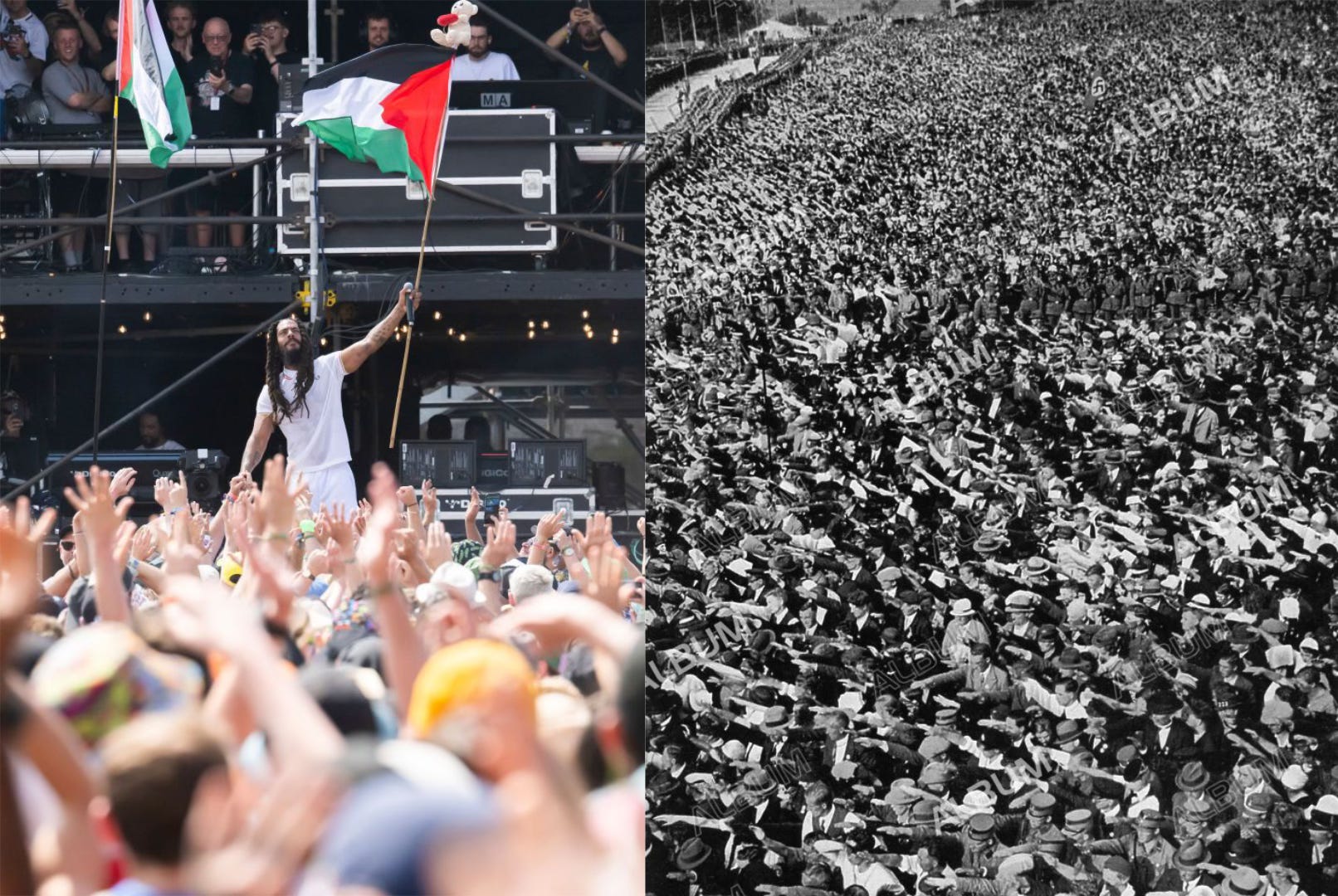
This week, at the Glastonbury Festival—a pop culture bacchanal so smugly progressive it could probably qualify for an EU climate grant—a vast crowd of young, educated Westerners stood shoulder to shoulder and chanted “Death to the IDF.” The footage, available in glorious 4K with multiple TikTok angles, would not have been out of place in Berlin, circa 1933, except that the slogans now come with hashtags.
There were other chants too—“From the river to the sea,” “Free Palestine”—each repeated with all the intellectual rigor of a trance mantra, but with none of the historical literacy. One could almost hear the algorithms humming behind them. That these slogans, in practice, advocate for the erasure of the world’s only Jewish state and the political disenfranchisement of its citizens did not seem to trouble the crowd. Why would it? They were not there to think. They were there to belong.
What is frightening about Glastonbury is not the presence of antisemitism. It is the absence of shame.
THE NEW POLITE ANTISEMITISM
If Gessen represents the ideology of denial, and Glastonbury its popular pageant, then the media and academic consensus have become the orchestra pit: supplying the necessary tones of moral elevation to what is, at base, a descent into polite barbarism.
The shift is not accidental. The Overton window—the range of socially permissible discourse—has moved. Not violently. Not with banners and book burnings. But quietly, subtly, in the name of justice and inclusion. The same institutions that once taught Holocaust memory and liberal universalism now host seminars on the colonial guilt of Jewish self-determination.
In this brave new lexicon, the term “Zionist” becomes a placeholder for Jew, “resistance” becomes a placeholder for terrorism, and “justice” becomes whatever ideological cudgel can be lifted against the inconvenient fact of Jewish existence.
THE THERMOMETER OF CIVILIZATIONS
Antisemitism has always served as a kind of civilizational thermometer. It does not merely indicate how Jews are treated. It reflects how a society handles reason, pluralism, dissent, and moral coherence. A healthy society can accommodate Jewish particularism. A sick society cannot.
By that measure, we are very ill indeed.
And like many terminal illnesses, the symptoms are not always obvious to the host. In America and Europe, antisemitism is no longer draped in swastikas or screamed by men in uniforms. It is shared in carousels. It is quoted from columnists. It is sung at music festivals. It is rationalized by those who should know better, and aestheticized by those who never cared to.
It has become fashionable. And fashion, as history teaches, kills faster than ideology.
THE PATIENT MAY NOT SURVIVE
The real worry is not for Israel, which is armed, alert, and acutely aware of history. The worry is for the West, which is not. A civilization that cannot distinguish between a pluralistic democracy and a genocidal militia is not just morally confused. It is functionally suicidal.
The decline may be slow, but it is not indefinite. Civilizations do not expire all at once. They die in increments: first by forgetting what they stood for, then by forgiving those who seek to undo it, and finally, by turning against those who dare to remember.
We are not yet at the end. But we are well past the warning signs. And when the canary keels over, the proper response is not to write a thinkpiece about its political motivations.
The proper response is to stop the gas.
POSTSCRIPT
If you’ve made it this far, you’re exactly the kind of reader I want to hear from. Whether you agree, dissent, or feel uncomfortably torn—write back.
Comment. Share. Argue. Dissect.
This isn’t a sermon—it’s a spark. And if we’ve reached the point where antisemitism can be rebranded as nuance and “Death to the IDF” passes as musical protest, then we no longer have the luxury of polite silence.
So let’s have the hard conversation.
Publicly. Bluntly. Intellectually. Before the lights go out.
Thank you for sharing your thoughts. I have to admit, reading this wasn’t easy, partly because you managed to put into words, with such precision, what I see myself when I look at, let's say, Europe from the outside. I'd be interested to hear more from you about possible ways forward or solutions, though I realize there may not be clear answers to questions like these.