
The Extraction
Power, law, and moral triage after Maduro

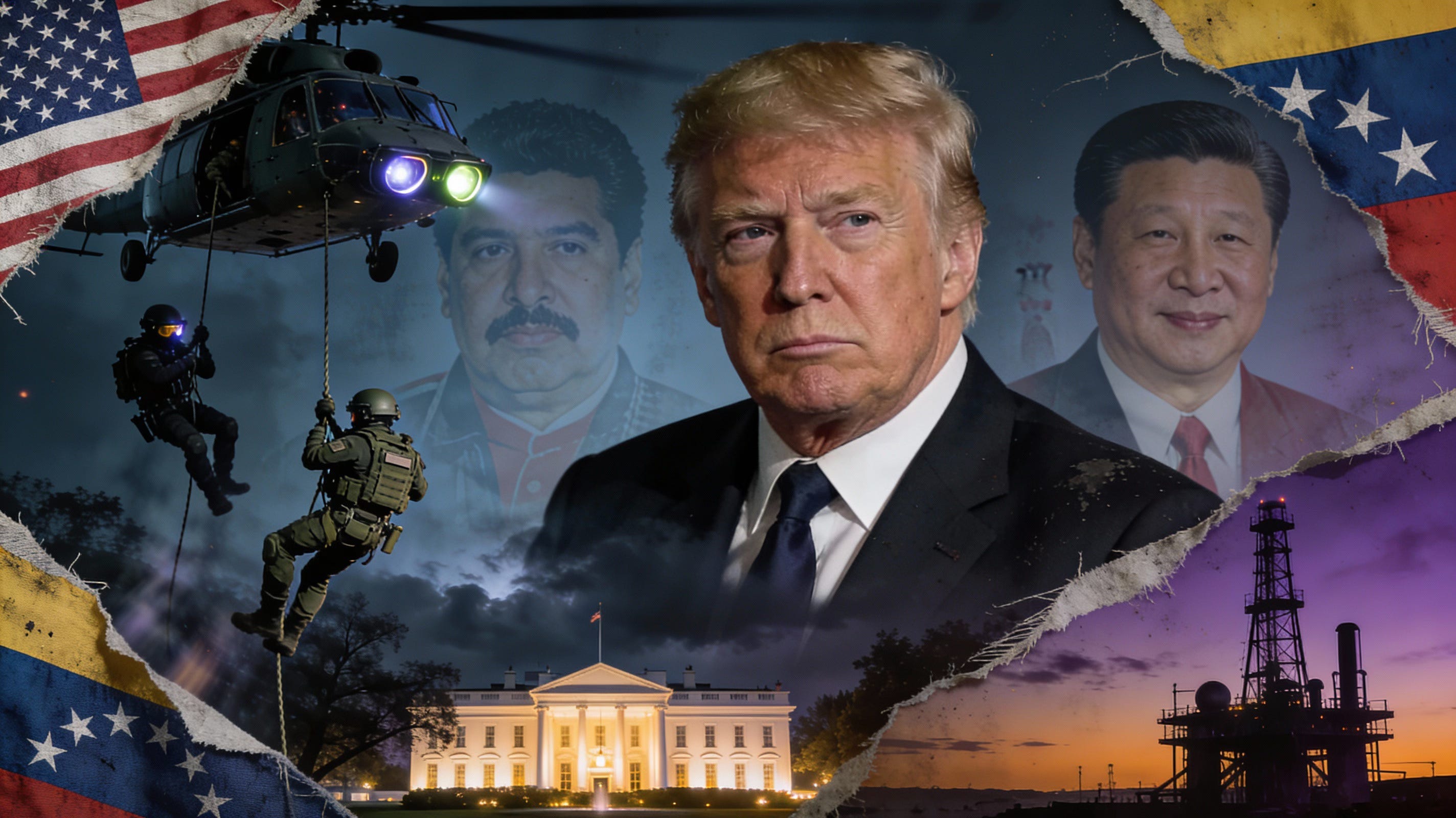
PROLOGUE — AN UNSETTLING REACTION
I didn’t expect to pause over this.
When reports appeared that Nicolás Maduro had been removed from the center of power, I didn’t feel the urge to react immediately. The event registered as something that required attention before judgment. An action had taken place that resisted instant classification and deserved to be examined on its own terms.
The operation was narrow and decisive. A ruler who had relied on institutional protection was taken out of his own seat of control, in full view of the structures designed to secure him. The scale was limited. The execution was precise. The signal extended beyond the individual involved.
Effects like this do not remain local. They alter expectations. They reshape assumptions about durability and safety among people who govern through fear and routine. Structures built to convey permanence begin to look contingent. Loyalty becomes a variable rather than a constant.
Authoritarian leaders carry a private calculation that rarely surfaces in public language. It concerns personal exposure rather than ideology. That calculation just changed.
This unsettled me because it cut across my usual reflexes. I remain skeptical of power exercised through secrecy and speed. I remain uneasy with executive authority acting without broad institutional constraint. I remain alert to how often violence is justified retrospectively through appeals to necessity. None of those concerns dissolved. They coexist with the recognition that dismissing this event as noise or symbolism would be evasive.
Something concrete occurred.
The comparison that followed came from a professional instinct. Russia has spent years attempting to capture or eliminate Volodymyr Zelenskyy and has failed, thankfully, despite proximity, sustained effort, and a readiness to devastate civilian space. The United States removed Maduro within hours. The difference lay in preparation, intelligence coordination, logistics, and execution. These are operational facts rather than moral commentary.
Capability remains a condition of survival. Open societies persist because they maintain overwhelming capacity across economic, technological, and military domains. History does not offer examples of freedom sustained by intention alone. Norms function when enforcement exists. Human dignity survives within systems that can protect it.
Liberal societies place a high value on individual life. That valuation shapes restraint, hesitation, and internal debate. Authoritarian systems operate with a different arithmetic, one that treats mass expendability as an available instrument. This asymmetry defines contemporary conflict and explains recurring strategic imbalance.
Excess capacity follows from this reality. Enough to absorb error. Enough to neutralize intimidation. Enough to prevent sacrifice from functioning as leverage. Ideals persist within environments that allow them to persist.
The unease remains. It deepens. The event forces engagement with international law, institutional legitimacy, energy security, regional stability, and the widening distance between formal norms and operational conditions. It also raises questions about precedent, durability, and long-term consequence.
I’m not interested in defending personalities or signaling allegiance. I’m interested in understanding why this action registers as significant despite unresolved legal and ethical concerns, and why ritual invocations of international law increasingly fail to address situations where the underlying assumptions of that law have eroded.
That inquiry begins here.
CHAPTER I — THE EVENT, THE CLAIMS, THE OPEN FIELD
Events like this do not arrive as clean facts. They arrive layered, contested, and already shaped by competing interests. What follows is not a definitive account. It is an attempt to stay within what can be responsibly stated while acknowledging where narrative has already overtaken verification.
What appears clear is that Nicolás Maduro was removed from Venezuela in a U.S.-led operation that went beyond a single moment of extraction. Reporting describes strikes inside Caracas, followed by the capture of Maduro and his wife and their transfer to the United States, where they now face criminal proceedings. The operation was presented as the culmination of months of preparation and intelligence work rather than an improvised action. It unfolded quickly and decisively, then gave way to an unusually explicit political moment.
That moment came on January 3, when Donald Trump appeared with senior cabinet members and framed the operation in language that left little room for understatement. He did not present the action as a narrow intervention with limited political ambition. He spoke of the United States assuming responsibility for Venezuela during a transition period. He spoke of order, reconstruction, and oil. He spoke as though the question of authority had already been resolved.
This was not a technical briefing. It was a claim.
Trump’s language placed the United States in the position of interim administrator while offering few details about sequencing, duration, or mechanisms. Oil featured prominently, both as an economic asset and as a tool for reconstruction. U.S. companies were named as future partners in restoring Venezuela’s energy infrastructure. The administration’s legal framing blended law enforcement and military logic, with the Attorney General confirming that Maduro would face charges in U.S. courts.
The press conference did not close the story. It opened it.
Inside Venezuela, power did not collapse into silence. Delcy Rodríguez moved quickly to assert continuity, denouncing the U.S. action and claiming interim authority on behalf of the existing regime structures. The military did not fracture publicly. Ministries continued to operate. The state, hollowed out though it may be, remained present.
At the same time, María Corina Machado stepped forward and declared her own claim. She spoke as the legitimate representative of a Venezuela that had been stripped of sovereignty long before January 3. Her assertion carried moral weight among many Venezuelans and symbolic weight abroad. It also carried practical uncertainty. Her ability to translate legitimacy into control remains an open question. Still, her claim entered the field and reshaped it. Power in Venezuela now exists as competing assertions rather than a single center.
This is the reality that followed the operation. No clean transfer. No unified authority. No immediate stabilization. Instead, a contested space filled by overlapping claims, internal actors recalibrating their positions, and external players reassessing their leverage.
International reaction followed familiar lines. Condemnation came quickly from some governments. Calls for emergency sessions at the United Nations surfaced almost immediately. Appeals to sovereignty and international law resumed their customary rhythm. These reactions mattered diplomatically, though their capacity to shape outcomes remained uncertain.
Markets responded cautiously. Oil prices moved without panic. Regional governments watched closely without dramatic repositioning. The absence of immediate chaos did not indicate resolution. It indicated absorption. Systems under long-term stress often absorb shocks before revealing fracture.
What emerges from this sequence is not clarity, but a defined starting point. Maduro is no longer in Caracas. The United States has asserted a role that goes beyond enforcement and into governance, at least rhetorically. Multiple Venezuelan actors claim legitimacy. Foreign interests remain embedded. Oil stands at the center of both reconstruction hopes and geopolitical calculation.
Nothing about this configuration guarantees stability. Leadership removal does not dissolve networks. Criminal economies do not vanish with a signature. Foreign intelligence assets do not withdraw voluntarily. A transition spoken into existence does not administer itself.
This is the field as it stands. An act executed. A claim made. Authority contested. Futures opened rather than settled.
Any assessment of law, legitimacy, or precedent has to begin here, with a situation defined less by resolution than by exposure. The assumptions that usually structure international judgment are already under strain in this landscape. That strain did not begin on January 3. Venezuela simply brought it into focus.
That is the ground on which the next question arises: what international law presumes about sovereignty, responsibility, and legitimacy, and what happens when those presumptions no longer align with political reality.
CHAPTER II — THE LEGAL FRAME AND THE ASSUMPTIONS IT CARRIES
International law does not float above political reality. It rests on a set of premises about how states come into being, how they endure, and how responsibility attaches to power. These premises rarely need to be stated explicitly, because the system functions smoothly when they hold. Tension arises when they erode, not abruptly, but through gradual internal transformation.
At its core, the modern legal order presumes that states exercise effective authority over their territory, that they command institutions capable of enforcing decisions, and that those institutions remain sufficiently stable for responsibility to be meaningfully assigned. Sovereignty, within this framework, describes a condition rather than a title. It assumes continuity between decision, enforcement, and accountability over time.
This is the background against which legal judgments acquire meaning. Treaties bind because there exists a state capable of honoring or violating them. Prohibitions matter because breaches can be attributed to identifiable authorities. Enforcement, whether diplomatic, economic, or coercive, presupposes an actor that can respond to pressure in a predictable way.
The institutional architecture associated with the United Nations reflects these assumptions. Universal membership provides formal equality, while enforcement authority concentrates in a limited number of bodies whose design reflects geopolitical realities rather than legal idealism. The Security Council holds coercive power shaped by veto prerogatives. Judicial mechanisms rely on consent and cooperation. Human rights bodies generate scrutiny through documentation and exposure. The system prioritizes stability among major powers and manages compliance through gradual pressure rather than compulsion.
This structure works tolerably well when states retain functional coherence. It strains when coherence dissolves internally while formal recognition persists externally.
Venezuela’s political evolution over the past two decades illuminates this strain without exhausting it. The election of Hugo Chávez in 1998 took place squarely within the legal framework of electoral legitimacy. His project presented itself as a democratic correction grounded in socialist ideology and popular mobilization. Early international engagement treated Venezuela as a sovereign actor pursuing a distinct political path rather than as an aberration within the system.
As Chávez consolidated power, institutional balance shifted. Constitutional changes, judicial realignment, and political centralization unfolded through formal mechanisms that preserved outward legality while altering internal function. International law continued to recognize the Venezuelan state as a unitary actor capable of assuming obligations and responsibilities. The framework held because the form held.
After Chávez’s death, succession transferred authority to Nicolás Maduro, whose claim rested on continuity of movement and personal designation rather than renewed institutional consensus. Maduro’s ascent followed constitutional procedure in appearance, though contested in substance, and international recognition initially tracked that appearance. Legal continuity persisted even as political legitimacy thinned.
Throughout this period, international law continued to operate on its usual terms. Venezuela remained a treaty party, a forum participant, and a subject of monitoring rather than enforcement. Reports documented deterioration. Resolutions expressed concern. Sanctions targeted individuals. The system addressed Venezuela as a state whose internal developments remained legible within existing categories.
What this reveals is not a sudden failure of law, but the limits of its design. International law assumes that sovereignty degrades at the margins and corrects through pressure, dialogue, and time. It lacks mechanisms for addressing prolonged internal transformation that preserves formal attributes while hollowing out operational capacity. The framework can describe such situations. It struggles to resolve them.
By the time Venezuela reached the stage at which multiple actors contested authority, foreign security interests embedded themselves deeply, and illicit economies fused with governance, the legal vocabulary remained largely unchanged. The state still existed in law. The assumptions underpinning that existence had become increasingly strained in practice.
This gap between form and function accumulated over years. It did not originate with January 3. The operation that removed Maduro entered a landscape already shaped by that accumulation, one in which legal categories continued to apply formally while losing traction over outcomes.
Recognizing this gap does not answer the question of legitimacy. It clarifies why appeals to international law often speak past the conditions they seek to govern. Law presumes a substrate of responsibility that can erode without triggering categorical collapse. When erosion reaches a certain depth, actors confront a space in which legal process persists and enforcement recedes.
The January 3 action emerged within that space. Understanding it requires first understanding what international law assumes about states, and how those assumptions had already been placed under sustained pressure in Venezuela long before force entered the equation.
The analysis can now move forward to examine how those pressures culminated in a broader collapse of responsible sovereignty, and why that collapse altered the strategic calculus for actors beyond Venezuela’s borders.
CHAPTER III — THE UN’S STRUCTURAL LEGITIMACY PROBLEM
The legal frame outlined so far presumes institutions capable of carrying authority into consequence. That presumption directs attention toward the United Nations, because it is the arena where sovereignty, legality, and legitimacy are meant to intersect in practice. The Venezuelan case cannot be understood without recognizing how that arena has evolved and how its evolution shaped the range of options perceived as available.
From the outset, the United Nations functioned as a forum of recognition. Membership conferred standing. Participation signaled inclusion. Voting produced declarations that carried symbolic weight. Enforcement remained limited by design. This arrangement rested on a belief that legitimacy generated through procedure would exert pressure over time, especially when combined with diplomacy, exposure, and economic leverage.
As membership expanded, the composition of the institution shifted. States governed by authoritarian systems gained numerical weight in the General Assembly and, through regional allocation, secured positions across subsidiary bodies. Coordination followed naturally. Voting blocs formed around shared interests rather than shared standards. Procedural discipline became a substitute for deliberation. Legitimacy inside the system began to reflect coalition arithmetic.
The Human Rights Council illustrates this development with particular relevance for Venezuela. Elections frequently proceeded without competition, allowing governments with extensive records of repression to enter the body and acquire procedural authority. Once seated, members participated fully in shaping agendas, mandates, and resolutions. Scrutiny remained visible. Leverage remained elusive. The Council produced language, reports, and sessions that reaffirmed concern while leaving underlying dynamics unchanged.
Venezuela moved through this environment for years. Its government remained present as a recognized sovereign participant. Its internal transformation unfolded under sustained observation. Institutional response followed established patterns: documentation, debate, expressions of concern, targeted sanctions. The form of engagement persisted. The substance of influence diminished. Recognition continued to flow even as the capacity and willingness to meet the responsibilities that recognition presumes weakened.
Democratic governments contributed to this equilibrium. Their participation reflected calculation rather than illusion. Engagement preserved access to diplomatic channels, intelligence cooperation, humanitarian coordination, and energy relationships. Confronting the composition of the institution carried costs that appeared immediate. Accommodating it promised manageability. Over time, accommodation solidified into routine.
The logic reinforced itself. As authoritarian governments gained seats and influence, mutual support eased their passage into additional bodies. Each successful entry lowered the threshold for the next. Legitimacy within the system became easier to obtain through alignment than through conduct. The language of rights and sovereignty remained intact while its constraining force thinned.
In this setting, the UN’s role in cases like Venezuela settled into a familiar pattern. It served as a stage for reaction and positioning. Statements and resolutions marked alignment. Emergency sessions signaled concern. None of this translated into authority capable of reshaping conditions inside a state whose internal configuration no longer responded to institutional pressure.
This history matters for understanding the January 3 action, not because the United Nations once held decisive leverage that was suddenly bypassed, but because its role had long been confined to presentation rather than resolution. Appeals to UN authorization retained symbolic resonance while offering limited guidance for altering outcomes on the ground.
By the time the United States acted, the institutional environment was already defined. Legitimacy circulated through procedure. Enforcement remained external to the system. States with operational capacity assessed risk and interest within that reality. Venezuela’s case unfolded inside this structure for years, accumulating reports and resolutions without changing trajectory.
The UN’s structural legitimacy problem therefore forms part of the background rather than the trigger. It explains why references to the institution functioned primarily as rhetorical markers once the operation occurred. It also explains why the absence of prior authorization failed to settle the question of legitimacy for many observers who had watched the institutional process run its course without effect.
This brings the analysis back to Venezuela itself. Institutional limits intersected with internal transformation, producing a condition where sovereignty existed formally while responsibility dissipated in practice. That intersection defines the collapse of responsible sovereignty and frames the strategic calculus that followed.
CHAPTER IV — VENEZUELA AND THE EROSION OF RESPONSIBLE SOVEREIGNTY
The institutional setting described so far only becomes fully intelligible once it is placed alongside the internal trajectory of Venezuela itself, because the decisive development was neither sudden nor spectacular, but gradual, cumulative, and largely invisible from the outside for a long time. What unfolded was a transformation of sovereignty that preserved its legal shell while steadily draining it of operative substance, until recognition and responsibility no longer aligned in any meaningful way.
For much of the twentieth century, Venezuela functioned as a broadly conventional state, with imperfect but recognizable institutions, an economy integrated into global markets, and a political system that oscillated within established boundaries. That equilibrium began to shift with the rise of Hugo Chávez, whose electoral victory in 1998 rested on genuine grievances and authentic popular support. Corruption, inequality, and elite capture were widely experienced realities, and Chávez articulated a socialist and nationalist project that promised redistribution, dignity, and a reclaiming of popular sovereignty. In its early phase, this project operated through elections, constitutional change, and public mobilization, preserving the outward forms of legality while gradually reshaping how power functioned inside the state.
Over time, authority concentrated increasingly in the executive, judicial independence weakened through formal realignment rather than overt rupture, and political loyalty displaced institutional competence as the primary criterion for advancement. High oil revenues during the 2000s supplied the resources that made this configuration sustainable, financing expansive social programs while obscuring the steady erosion of administrative capacity and regulatory coherence. From the outside, sovereignty appeared intact, because the state continued to act as a unified subject in international forums and to speak in the language of constitutional order.
The death of Chávez exposed the fragility beneath that appearance. Succession passed to Nicolás Maduro, whose authority rested more on designation and continuity of movement than on renewed institutional consensus. His narrow and contested electoral victory intensified polarization and further weakened the already strained relationship between formal institutions and public consent. As economic conditions deteriorated and oil revenues contracted, governance shifted away from administration and toward control, with security services acquiring an increasingly political role, civil institutions losing autonomy, and informal networks stepping into spaces the state no longer managed effectively.
This shift altered how sovereignty was experienced on the ground. Large parts of the country ceased to encounter the state as a provider of order or protection and instead encountered overlapping structures of power that blended official authority with armed groups, criminal organizations, and patronage networks. Borders became porous, not in a metaphorical sense, but in the practical sense that trafficking routes, smuggling corridors, and illicit economies expanded with limited interference. Foreign actors found entry points in a landscape where oversight had thinned and where regime survival depended increasingly on external support rather than domestic legitimacy.
Over time, the Venezuelan state came to function less as a coherent authority than as a layered arrangement in which formal institutions continued to exist and participate diplomatically while effective control dispersed across security services, militias, criminal enterprises, and external patrons whose interests aligned with regime endurance rather than public welfare. Responsibility diffused along with authority, producing decisions whose consequences were borne by the population without any clear mechanism of accountability.
This condition shaped the language used by domestic opponents and critics. María Corina Machado described Venezuela as a country already penetrated by foreign security services, transnational militant organizations, and organized crime operating with regime tolerance, a description that reflected lived experience rather than rhetorical excess. In this account, sovereignty existed as a legal claim while control operated through networks that answered to different incentives and different centers of power.
Once sovereignty reaches such a stage, its meaning changes in practice. Territorial integrity persists as a formal assertion even as uniform control across territory dissolves. Political independence coexists with reliance on external protection and illicit revenue streams. International recognition continues to flow to a government that no longer fulfills the responsibilities that recognition presumes. The state remains a subject of law, yet it no longer performs the functions that give that law practical substance.
This erosion did not provoke a decisive international response, largely because the outward form of statehood remained intact. Venezuela continued to hold a seat, sign treaties, and participate in diplomatic processes, allowing the international system to address it as a sovereign actor even as the internal conditions that sovereignty assumes slipped further out of alignment. Pressure accumulated without producing correction, because there was no longer a unified authority capable of absorbing pressure and translating it into reform.
By the time Maduro was removed, Venezuela no longer resembled the kind of actor international law presumes when it speaks of sovereignty and responsibility. The state had become a conduit through which power flowed rather than a structure that organized and constrained it, and removing the individual at the center of that conduit disrupted an already unstable configuration without restoring coherence.
This helps explain both the resonance of the operation and the uncertainty that followed. It was widely perceived as an intervention into a vacuum rather than an intrusion into a functioning order, and the absence of immediate collapse reflected absorption rather than stability, as networks recalibrated and external actors reassessed their positions.
Venezuela now stands at an inflection point shaped by this long erosion. The question that follows is no longer confined to formal violation or compliance. It concerns whether sovereignty, understood as a responsible and operative condition, had already ceased to exist in the way international law assumes. That question leads directly into the next layer of analysis, where internal collapse intersects with external interest, and where energy security, regional stability, and geopolitical competition shape what comes next.
CHAPTER V — WHY THIS IS NOT UKRAINE
The comparison with Ukraine surfaced almost immediately, and it did so with a force that was less analytical than reflexive, as though the invocation of one conflict could settle another by association alone. The argument followed a familiar pattern: force crossed a border, sovereignty was breached, therefore moral and legal equivalence followed as a matter of course. Once that conclusion is accepted, further differentiation appears unnecessary, even suspect.
This way of reasoning relies on compression rather than examination, and it obscures more than it clarifies.
Russia’s war against Ukraine unfolded as a project aimed at domination rather than disruption, with military force deployed across broad fronts and sustained over time, transforming cities, infrastructure, and civilian life into instruments of pressure. The objective extended beyond leadership change toward the reconfiguration of political reality itself, accompanied by territorial claims, administrative absorption, and an explicit challenge to Ukrainian national existence as a distinct and legitimate entity. Violence was not a means toward a limited end. It became the environment in which the end was pursued.
The situation in Venezuela developed along a different trajectory and was addressed through a different form of action. The operation that removed Maduro did not unfold as a campaign directed at society, nor did it seek to impose a new political order through prolonged coercion. It did not mobilize the population as a target, redraw borders, or attempt to reshape identity through force. Its focus remained narrow, directed at an individual who had come to symbolize continuity within a system that had already ceased to function as a responsible sovereign authority.
This distinction cannot be reduced to intention alone. It resides in scale, duration, and the relationship between force and civilian life. In Ukraine, violence produced collapse, displacement, and destruction on a scale that defined daily existence for millions. In Venezuela, collapse preceded the use of force, emerging through years of institutional erosion, criminal integration, and foreign penetration that hollowed out governance while preserving legal form. The operation intervened in a space where authority had already fragmented and where the state’s capacity to protect its population had long since weakened.
The analogy also reverses causality. Russia’s invasion created the conditions it later claimed to address, while Venezuela’s internal disintegration created conditions that external actors assessed as already destabilizing beyond its borders. Treating both cases as interchangeable expressions of illegality flattens this difference and substitutes moral symmetry for contextual judgment.
This does not remove unease. It relocates it. Once sovereignty is understood as a condition tied to responsibility and control rather than as a static label, the question shifts from whether force crossed a border to what kind of political reality existed on the other side of that border. Ukraine presented a functioning state exercising authority, defending territory, and commanding public loyalty. Venezuela presented a layered structure in which formal recognition coexisted with dispersed control, external security involvement, and criminal governance that no longer answered to a unified public interest.
Opposition to Russia’s war does not require the suspension of judgment elsewhere. Condemnation of conquest does not mandate acceptance of every regime that invokes sovereignty as a shield while abandoning the obligations that give that concept meaning. When all uses of force are treated as morally identical, judgment gives way to ritual, and responsibility dissolves into abstraction.
The discomfort surrounding this distinction reflects a deeper tension. Liberal frameworks seek rules that apply uniformly and predictably, offering moral clarity through consistency. Strategic reality produces cases that resist such uniformity, because the conditions that rules presume have already eroded. Venezuela belongs to that category. The challenge lies in acknowledging difference without converting it into license.
This recognition prepares the ground for what follows. If the Venezuelan operation cannot be understood through the lens of Ukraine, its significance has to be sought elsewhere, in the way power operates within systems built on personal rule, in how deterrence reshapes elite calculation, and in how fear migrates once permanence loses credibility.
CHAPTER VI — POWER, DETERRENCE, AND THE RECALIBRATION OF FEAR
Once the comparison with Ukraine is set aside, the analysis shifts into a different register, one that concerns the internal mechanics of power in systems built around personal rule rather than institutional accountability. In such systems, authority rests less on law or procedure than on the perception of permanence, and fear operates less as a diffuse condition imposed on society than as a carefully managed instrument circulating within a narrow elite.
Dictatorial power relies on the expectation that removal remains implausible, that palaces endure, that security services remain loyal under all conditions, and that proximity to the center confers a durable form of insulation. When these assumptions hold, they rarely require explicit reinforcement. They settle into the background of political life and begin to function as axioms. Once they weaken, however, the entire architecture of control requires constant maintenance, because the credibility of fear depends on the belief that consequences flow in only one direction.
Targeted removals intervene precisely at this level of expectation. Rather than mobilizing fear among the population, they disrupt the internal calculations that govern elite behavior. When a ruler is removed from the core of power while the institutions designed to guarantee his security remain formally intact, the effect propagates through networks of loyalty, patronage, and protection far more effectively than through public messaging. What changes is not ideology, but risk assessment. Actors who previously treated permanence as a given begin to reassess exposure, dependence, and the reliability of the structures on which their survival has rested.
This is where deterrence takes on a form distinct from conventional military doctrine. The objective does not lie in imposing cost through destruction or in coercing compliance by inflicting pain on society at large. It lies in altering expectations at the level where decisions are made, by demonstrating that insulation is conditional and that distance from consequence cannot be taken for granted. Fear, in this configuration, migrates upward rather than outward, concentrating among those whose authority depends on the presumption that they cannot be reached.
The moral asymmetry between open societies and authoritarian regimes shapes this dynamic in fundamental ways. Liberal systems place a high value on individual life, embedding restraint into both law and political culture, so that decisions carrying the risk of civilian harm generate immediate ethical and institutional cost. Authoritarian systems operate under a different arithmetic, one in which mass expendability functions as a governing resource and where suffering can be absorbed, redirected, or concealed without threatening the ruling core. This asymmetry produces a persistent strategic imbalance, particularly in conflicts where endurance and indifference to loss outweigh innovation and precision.
Overwhelming capacity functions as a compensatory mechanism within this imbalance. Excess capability alters calculation by rendering sacrifice ineffective as a strategy and by stripping bravado of its utility. When error can be absorbed without collapse, intimidation loses value as a political tool. When protection ceases to guarantee immunity, loyalty becomes contingent on factors that can shift rapidly. Deterrence, in this sense, emerges less from declarative red lines than from demonstrated reach and credible follow-through.
The removal of Maduro resonated within this framework. It addressed a ruler who had relied on the appearance of untouchability while presiding over a system that diffused responsibility, tolerated criminal integration, and depended on external protection. The operation signaled that even such configurations possess limits, and that personal power, however entrenched it may appear, remains vulnerable to external reach under certain conditions. The relationship between authority and consequence was recalibrated in a way that formal condemnation alone had failed to achieve.
This recalibration carries risk that cannot be dismissed. Deterrence, once normalized, can lose discrimination. Actions that prove effective in reshaping elite calculation once may lower thresholds for repetition, especially in political systems where executive authority already enjoys broad latitude. Strategic success does not dissolve the need for institutional restraint, and fear, once weaponized, resists clean containment.
Within the context established so far, however, the recalibration of fear explains why the operation registered beyond Venezuela itself. It spoke to regimes that survive through managed permanence and elite insulation, and it did so without mobilizing society as a battlefield or converting civilian life into an instrument of pressure. It altered expectation rather than imposing occupation.
This prepares the ground for the next layer of analysis, where strategic signaling intersects with material interest. Venezuela’s condition carried weight beyond symbolism because it rested atop a resource that shapes vulnerability and leverage across borders. Energy does not merely finance regimes. It structures security for those who depend on its flow, and it shapes the stakes of intervention in ways that extend far beyond any single country.
CHAPTER VII — ENERGY, OIL, AND DEMOCRATIC SECURITY
Once the discussion reaches energy, the tone of the debate often becomes cynical very quickly, because oil has a way of dragging moral language into contact with material dependency. This cynicism is understandable. It also becomes evasive when it is used to avoid thinking clearly about what energy means for open societies, and about how energy insecurity functions as a strategic vulnerability that authoritarian systems have learned to exploit.
Venezuela sits at the center of this problem because it combines vast hydrocarbon reserves with a long period of institutional decay, criminal integration, and geopolitical entanglement. The country’s oil is not merely an economic resource. It is a lever that shapes regional stability, migration pressure, cartel economics, and the ability of external powers to project influence into the Western hemisphere. When such a lever is controlled by a regime that survives through predation and external patrons, the consequences do not remain local, even when the humanitarian catastrophe is experienced locally first.
Energy security does not mean cheap fuel. It means predictability of supply, resilience of infrastructure, and the absence of coercive dependence on hostile actors. Open societies experience energy instability as a multiplier of political fragility, because price spikes feed social unrest, weaken governments, inflame polarization, and distort budgets in ways that reduce long-term capacity. Authoritarian systems understand this and treat energy as a geopolitical tool, using access, denial, and price manipulation to shape decisions in democratic capitals where leaders remain bound by electoral cycles and public pressure.
From this angle, a functioning Venezuelan energy sector matters well beyond Venezuela, because it can function as a stabilizing element in global supply and as a counterweight against the concentration of leverage in fewer hands. It matters for the United States, which remains the central security provider for the Atlantic democracies and whose strategic choices ripple outward through markets, alliances, and deterrence credibility. It also matters for European democracies whose economic and political health remains sensitive to energy volatility and to the costs imposed by hostile regimes seeking leverage.
This is where the moral discomfort reappears, because the national interest driving U.S. action in Venezuela does not require altruism, and it does not depend on benevolent intention. The United States acts primarily for its own security, its own economic interest, and its own strategic positioning. That is the normal condition of state behavior. The more important question concerns secondary effects and whether the pursuit of national interest can align with outcomes that reduce long-term harm beyond the initiating state.
Stabilization of Venezuela, if it becomes real, would generate benefits that extend outward. It would reduce migration pressure across the region, which has already strained neighboring states and contributed to destabilization within transit countries. It would constrain the operating space for cartels and trafficking networks that exploit institutional collapse as a business model. It would diminish the utility of Venezuela as a platform for external patrons seeking influence, disruption capacity, and proximity to U.S. territory. It would increase global supply resilience and reduce the concentration of energy leverage in regimes that treat supply as a tool of coercion.
None of these outcomes are guaranteed. Each depends on conditions far more demanding than the removal of a ruler.
Oil infrastructure is not a shortcut to governance. Rebuilding production capacity can generate revenue. That revenue can finance reconstruction, state capacity, and social stabilization when institutions exist to channel it into public goods. That same revenue can entrench capture when institutions remain hollow and when coercive structures retain control over distribution. Venezuela’s history illustrates how oil wealth can fund social programs in one phase while financing corruption and repression in another, depending on institutional integrity, transparency, and the balance between civil authority and coercive power.
The January 3 press conference added this dimension explicitly by placing oil and reconstruction at the center of the U.S. political narrative, with rhetoric about U.S. firms rebuilding Venezuela’s energy sector and about directing the country through a transition. That rhetoric can be read in several ways. It can be interpreted as opportunism. It can be interpreted as strategic planning grounded in material reality. It can be interpreted as a form of signaling to markets and allies. It can also be interpreted as an attempt to convert operational success into a public-facing economic rationale, which remains politically necessary in a democracy where foreign action demands justification beyond strategic abstraction.
Each reading carries some plausibility. None resolves the underlying gamble.
The gamble lies in the difference between extraction and stabilization. Extraction can be executed through concentrated competence and secrecy. Stabilization requires persistence, legitimacy, and administration. It depends on domestic partners able to govern, enforce law, and rebuild institutions while resisting capture by the same networks that thrived under collapse. It depends on controlling coercive actors rather than merely removing their patron. It depends on creating mechanisms for revenue that reduce predation rather than feeding it.
This is where María Corina Machado’s description becomes central again, because she framed Venezuela as an already invaded space where foreign agents, militant organizations, and criminal networks operate with regime tolerance. If this diagnosis is even partially accurate, then reconstruction of oil infrastructure becomes inseparable from the security problem, because infrastructure attracts capture in environments where coercive actors remain embedded. Oil wealth can finance stabilization, and it can finance a more sophisticated form of predation that wears the language of transition.
Energy security for democracies therefore intersects with governance capacity inside Venezuela. The political hope attached to the operation depends on more than producing barrels. It depends on whether a legitimate authority can consolidate control over territory, reduce cartel dominance, dismantle trafficking networks, and deny foreign militant organizations the operating space they previously enjoyed. Without these elements, increased oil output risks becoming a revenue stream that perpetuates instability under a new configuration.
The democratic interest in Venezuelan stabilization remains real even when initiated selfishly. Open societies benefit when energy supply becomes more resilient and less coercible, when regional migration pressure decreases, and when transnational criminal networks lose their operating base. These outcomes align with U.S. interest first, yet they extend beyond it in ways that matter for allied democracies and neighboring states.
The hard honesty required here concerns trade-offs and time horizons. Short-term gains, such as increased supply or geopolitical signaling, can be achieved relatively quickly. Institutional reconstruction requires years, and it requires a level of persistence that democratic politics does not always sustain, especially when attention shifts and domestic conflict consumes the agenda. The risk is not merely failure. The risk is partial success that creates new rents and new capture opportunities, leaving Venezuela trapped in a modified version of the same collapse.
Energy, in this sense, functions as both motive and test. It helps explain why Venezuela drew attention beyond humanitarian concern. It also provides a measure of whether the intervention can lead toward stabilization rather than merely rearranging control. Oil can support a transition when governance can discipline it. Oil can also sabotage a transition when governance remains weak.
CHAPTER VIII — THE CHINA VARIABLE
Any attempt to understand what follows the removal of Maduro has to take seriously an actor whose presence in Venezuela was never contingent on a single individual and whose strategic horizon does not operate on electoral or media cycles. China’s engagement with Venezuela developed gradually, through finance, infrastructure, and long-term positioning, and it did so in a manner that treated institutional weakness as a manageable condition rather than as a disqualifying risk. What happens next will depend less on public declarations than on how Beijing recalibrates its expectations under altered political conditions.
China entered Venezuela during the years when oil revenues still masked structural decay and when Western democracies increasingly framed the country as diplomatically difficult rather than strategically central. Large-scale loans were extended against future oil deliveries, infrastructure projects followed under bundled arrangements that tied Venezuelan assets to Chinese firms and standards, and the relationship took on a familiar form in which access to resources was exchanged for capital without governance-related conditionality. For a regime seeking insulation from Western pressure, this offered predictability. For China, it offered leverage anchored in debt, energy, and political alignment within a region traditionally shaped by U.S. influence.
This relationship never depended on ideological affinity. It rested on asymmetry. Venezuela required financing and external backing to compensate for internal erosion. China sought long-term access and strategic optionality rather than short-term returns. As Venezuelan institutions weakened and administrative capacity thinned, Chinese engagement adjusted accordingly, with projects increasingly structured to manage exposure, contractual terms tightened to secure repayment, and risk distributed across scale rather than mitigated through accountability mechanisms. Venezuela shifted from a development partner into a strategic node whose value lay in positioning as much as in performance.
The erosion of sovereignty described earlier shaped this dynamic profoundly. As governance hollowed out, Chinese investment neither withdrew nor expanded dramatically. It settled into a holding pattern that prioritized preservation of sunk costs, maintenance of leverage, and insulation from volatility. Venezuela became less a site of growth than a site of containment, useful insofar as it anchored influence and constrained competitors without requiring active transformation.
The removal of Maduro unsettles this configuration without dissolving it. China did not invest in a man. It invested in access, contracts, debt structures, and strategic presence. Those interests remain in place even as the political landscape shifts. What changes is the mechanism through which those interests can be pursued and protected.
Several strategic paths now present themselves, each carrying distinct implications. China may choose a cautious retrenchment, seeking to minimize exposure while securing repayment where possible and reducing visibility until the contours of Venezuelan authority become clearer. Such an approach would reflect risk management rather than disengagement, treating the situation as temporarily unstable rather than definitively lost.
Alternatively, China may attempt consolidation, leveraging existing debt and infrastructure to maintain influence during any transition, particularly if Western engagement appears fragmented, politically contested, or short-lived. In this scenario, continuity of interest substitutes for continuity of leadership, and presence becomes leverage precisely because alternatives remain uncertain.
A third possibility involves recalibration at a broader strategic level, where reduced influence in Venezuela is absorbed into a wider bargaining posture vis-à-vis the United States and its allies. Under this approach, Venezuela functions less as a primary asset than as a variable within global negotiation, its significance shaped by timing and trade-offs rather than intrinsic value alone.
Which of these paths prevails will depend on factors that extend well beyond Caracas. The durability of U.S. commitment matters more than initial demonstration. Signals of persistence narrow strategic options. Signals of hesitation invite opportunism. China’s calculations respond less to declaratory intent than to sustained engagement that alters the risk-reward balance over time.
The Venezuelan case also intersects with a broader pattern in China’s external strategy, particularly in environments marked by weak governance and institutional fragility. Investments structured around resource access and political insulation have produced mixed outcomes across multiple regions, generating leverage alongside exposure to instability that resists managerial control. Venezuela now occupies a visible position within that pattern, watched not only for its own outcome but for what it reveals about the viability of long-term positioning in collapsed or collapsing states.
For the United States, this dimension raises questions that extend beyond regime removal. Disrupting a leadership structure alters a network without dismantling it. Chinese leverage embedded through contracts, debt, and infrastructure persists unless it is renegotiated, diluted through institutional rebuilding, or rendered irrelevant by credible alternative partnerships. Stabilization efforts that overlook this layer risk reproducing dependency under a different configuration rather than reducing it.
This brings the analysis back to the central uncertainty running through the entire episode. Extraction constitutes an act. Stabilization unfolds as a process shaped by persistence, credibility, and competition. External actors adjust continuously during that process, testing resolve, probing gaps, and repositioning their bets. China’s response will offer an early indicator of whether Venezuela moves toward consolidation or drifts into a prolonged contest over influence.
The implications extend beyond Venezuela itself. They touch on how great-power competition plays out in spaces where sovereignty has thinned and legitimacy remains contested, and they expose the limits of one-off actions in environments shaped by long-term strategic investment.
CHAPTER IX — THE TRUMP QUESTION WITHOUT TRIBALISM
At this point in the argument, the analysis encounters an obstacle that is political rather than conceptual, because any attempt to assess the operation inevitably collides with the figure who authorized it, and that collision has a way of collapsing discussion into reflex, allegiance, or rejection before substance has a chance to surface. Donald Trump does not enter this story as a neutral vessel of state power. He enters it as a polarizing actor whose relationship to institutions, norms, and restraint has been contentious from the beginning, and whose presence distorts judgment even when the action under review demands to be considered on its own terms.
The difficulty lies in the tendency to fuse action and actor into a single moral object, as though approving or condemning one automatically settles the other. That fusion is emotionally satisfying, yet analytically corrosive, because it allows personal disposition to substitute for evaluation and turns complex questions of power, legality, and consequence into tests of tribal loyalty. The result is a debate that oscillates between absolution and damnation while bypassing the harder task of holding multiple truths in view at once.
It remains possible, and necessary, to acknowledge that Trump’s relationship to executive authority has long raised legitimate concern, particularly in his willingness to test boundaries, personalize power, and treat institutional constraint as an obstacle rather than as a safeguard. His rhetorical style rewards spectacle over precision, and his impatience with process creates risk in domains where legitimacy depends on more than operational success. None of this dissolves simply because an action produces a result that appears strategically coherent.
At the same time, reducing the Maduro extraction to a mere extension of Trump’s personality risks a different form of evasion, because it avoids engaging with the structural conditions that made the operation conceivable and the strategic logic that gave it resonance beyond partisan lines. The operation was not improvised in a vacuum, nor did it arise solely from personal impulse. It drew on intelligence capacity, logistical coordination, and institutional competence that exceed any individual officeholder, even when that officeholder dominates the narrative.
This tension becomes sharper when questions of checks and balances enter the frame. Executive action undertaken without explicit congressional authorization raises concerns that extend beyond the case at hand, because precedent accumulates regardless of intent. Powers exercised once can be exercised again under different circumstances, by different actors, with different justifications. Liberal systems depend on constraint precisely because competence and restraint do not reliably coincide in the same hands over time.
Here, discomfort is not a weakness. It functions as a signal that something consequential has occurred without resolving whether it should be normalized. An operation can register as strategically intelligible while remaining institutionally troubling. A result can appear beneficial while the method unsettles. Refusing to hold these tensions simultaneously does not produce clarity. It produces simplification.
The temptation, especially among Trump’s critics, lies in dismissing the action as illegitimate by association, treating any outcome as tainted by its author and therefore unworthy of further consideration. The opposing temptation, often visible among his supporters, lies in converting operational success into blanket validation, treating result as retroactive justification for method and motive alike. Both impulses bypass judgment in favor of identity.
A more demanding approach accepts that liberal democracies occasionally produce actions that advance strategic interest while straining institutional norms, and that the task of evaluation lies in resisting both reflexive rejection and reflexive endorsement. The Maduro extraction forces precisely this confrontation, because it exposes how thin the margin can be between decisive action and executive overreach, and how easily concern about one can be exploited to avoid grappling with the other.
This question cannot be resolved by appealing to Trump’s character alone, nor by isolating the operation from the political environment in which it occurred. It requires attention to the mechanisms through which power was exercised, the absence or presence of oversight, and the ways in which precedent will be interpreted by future administrations less constrained by scrutiny or less attentive to consequence.
The unease that persists at this stage is therefore not incidental. It belongs to the core of the liberal dilemma exposed by the operation. Strategic clarity arrived through means that complicate institutional comfort, and institutional comfort would likely have precluded the action altogether. The challenge lies in acknowledging both realities without collapsing into moral paralysis or power worship.
This leads directly into the final and most uncomfortable layer of the analysis, because once tribal judgment is set aside, what remains is the question that cannot be outsourced to institutions or personalities: how to navigate hypocrisy, selectivity, and moral triage in a world where no power acts universally, where inaction carries cost, and where the refusal to choose often protects the most predatory actors by default.
CHAPTER X — HYPOCRISY, SELECTIVITY, AND MORAL TRIAGE
At this stage, the argument arrives at the point where discomfort can no longer be displaced onto institutions, analogies, or personalities, because the remaining question concerns how moral judgment operates under conditions where power, limitation, and consequence intersect without offering clean resolution. The charge of hypocrisy surfaces here with particular force, often presented as a conversation-stopper rather than as a problem to be examined, as though inconsistency alone were sufficient to invalidate action regardless of context, capacity, or outcome.
The accusation carries intuitive appeal. States intervene selectively. They act where interests align and refrain where costs appear too high or benefits too uncertain. Venezuela receives attention while other collapsed or collapsing societies continue to absorb suffering without comparable response. This asymmetry feels morally uncomfortable, especially within liberal frameworks that aspire toward universality and equality of concern. Yet discomfort alone does not answer the question of what follows from recognizing selectivity as a permanent feature of political life.
No power capable of acting operates universally, because capacity itself imposes limits. Resources, attention, legitimacy, and endurance constrain what can be done, where, and for how long. Choices emerge within these constraints whether they are acknowledged openly or disguised beneath procedural language. Refusal to act does not suspend responsibility. It reallocates it. Consequences still unfold. The difference lies in who bears them and whether they are treated as inevitable or as the result of deliberate abstention.
This is where moral triage enters the frame, not as a rhetorical maneuver, but as a descriptive reality. In medicine, triage does not imply indifference to those left untreated. It reflects an assessment of urgency, survivability, and available means. In international politics, similar judgments occur constantly, often without explicit naming. Crises receive attention or fade. Regimes encounter pressure or remain insulated. Human suffering continues across all cases, yet intervention remains uneven.
The Venezuelan case forces this logic into the open. Decades of deterioration produced a society where institutional collapse, criminal integration, and external penetration combined to generate harm that extended beyond national borders. Migration flows reshaped regional dynamics. Trafficking networks expanded. Militant organizations found permissive space. Energy instability fed broader vulnerability. At some point, continued abstention ceased to resemble neutrality and began to resemble acquiescence to a configuration that rewarded predation.
Critics often respond by pointing to parallel cases where no comparable action occurred, treating inconsistency as proof of illegitimacy. The argument assumes that moral credibility depends on uniformity, and that deviation from universality nullifies the value of any particular intervention. This assumption carries a hidden cost, because it transforms imperfection into paralysis and allows the worst outcomes to persist unchallenged under the cover of moral purity.
Selectivity does not disappear when action is refused. It reappears in the distribution of attention, resources, and outrage. Some suffering becomes visible. Other suffering becomes background. The refusal to choose often protects entrenched systems of harm precisely because they operate beyond the threshold that triggers engagement. In this sense, selective action can disrupt inertia, even as it exposes inconsistency.
Hypocrisy enters the picture when moral language is used to obscure interest rather than to illuminate consequence. It appears when states claim universality while acting narrowly, or when they invoke law selectively to shield allies and punish adversaries without acknowledging the structural limits that shape their behavior. The problem lies less in selectivity itself than in the pretense that selectivity does not exist.
A more honest posture begins by accepting that no intervention emerges from moral cleanliness. Interests drive action. Power shapes possibility. Outcomes remain uncertain. The relevant question shifts accordingly, away from whether a state has acted everywhere it should have, toward whether action in a particular case plausibly reduces long-term harm compared to continued abstention.
In Venezuela, that question cannot be answered conclusively at this stage. Stabilization remains uncertain. Networks persist. External actors adapt. The operation may fail to produce durable improvement. It may generate new forms of capture. These risks remain real. They do not vanish through invocation of law or consistency.
What can be said with greater confidence is that prolonged inaction carried its own moral weight, one that accumulated quietly through displacement, exploitation, and the normalization of collapse. Treating abstention as morally neutral obscures this accumulation and allows harm to present itself as background noise rather than as consequence.
Moral triage does not offer comfort. It offers responsibility under constraint. It demands clarity about trade-offs, humility about outcomes, and vigilance against self-deception. It also requires resisting the temptation to treat hypocrisy as a veto rather than as a condition to be managed.
The Venezuelan case exposes this dilemma sharply because it sits at the intersection of humanitarian collapse, strategic interest, and institutional exhaustion. The decision to act does not cleanse the system of inconsistency. It interrupts one trajectory within it. Whether that interruption reduces suffering or merely rearranges it remains the central test.
That test cannot be passed through rhetoric alone. It unfolds over time, through persistence, restraint, and the willingness to accept accountability for consequences rather than retreating into either moral absolutism or strategic cynicism. The final question therefore turns away from judgment and toward orientation, asking how to hold hope without illusion once the slogans have fallen away and the future remains undecided.
EPILOGUE — HOPE WITHOUT ILLUSION
At the end of this inquiry, what remains is neither certainty nor closure, but a narrow space in which judgment can coexist with restraint, and where hope is permitted without requiring belief in inevitability. Venezuela’s future does not resolve itself through the removal of a ruler, nor does it collapse into futility simply because the path ahead is obstructed by uncertainty. The country stands within a landscape shaped by accumulated damage, competing interests, and expectations that have been recalibrated rather than settled.
The operation that removed Maduro altered the field without completing it. It exposed the fragility of arrangements that once appeared fixed and demonstrated that permanence in systems built on coercion and insulation remains contingent. At the same time, it left intact the deeper problems that defined Venezuela’s collapse, including fragmented authority, entrenched criminal economies, foreign influence, and institutional weakness that cannot be reversed through force alone.
Any optimism attached to this moment must therefore remain disciplined. Stabilization demands more than reconstruction plans or energy output. It requires sustained engagement with governance, law enforcement, and institutional rebuilding under conditions where trust has eroded and where the memory of predation remains recent. It also requires restraint from those who now possess leverage, because the temptation to convert advantage into control has derailed transitions elsewhere with remarkable consistency.
For Venezuelans themselves, hope carries a different weight. It is not abstract. It is measured in security, dignity, and the ability to live without negotiating daily existence through fear or dependency. External actors cannot manufacture that hope. They can, at best, create conditions under which it becomes possible to rebuild, provided they remain attentive to the ways in which intervention can reproduce the very dynamics it seeks to disrupt.
Neighboring states occupy a similar position of cautious expectation. Venezuela’s collapse did not stop at its borders. Migration reshaped societies across the region. Criminal networks extended their reach. Instability propagated quietly. Any movement toward recovery carries implications that extend outward, offering relief alongside new risks that demand coordination rather than celebration.
This moment also leaves open questions for democracies more broadly. Power exercised decisively can interrupt collapse. Power exercised without discipline corrodes legitimacy. Holding these realities together requires an unwillingness to retreat into comfort, whether that comfort takes the form of moral absolutism or strategic indifference. Clarity, in this sense, does not promise ease. It promises responsibility.
Refusing cynicism does not require confidence in success. It requires recognition that choices carry consequences even when outcomes remain uncertain, and that abstention constitutes a choice no less than action. The Venezuelan case brings this truth into focus by revealing how long decay can persist under the cover of procedure, and how abruptly assumptions can change once that cover is pierced.
What follows will unfold over years rather than days. Institutions will either reconstitute themselves or fracture further. External actors will either commit or drift. Expectations will either settle into a new equilibrium or collapse into renewed instability. None of this can be predicted with confidence.
The only defensible stance at this point lies in attention rather than prophecy, in solidarity rather than spectacle, and in the refusal to allow complexity to become an excuse for detachment. Hope, when stripped of illusion, does not guarantee redemption. It preserves the possibility that judgment, restraint, and persistence might still shape a future less brutal than the past.